
According to multiple news sources — all featuring their own take on comments that Steven Sim, Malaysia Deputy Finance Minister II, shared recently about the upcoming Budget 2024 — small- and medium-sized enterprises (SMEs) will be one of the key focuses.
Sim also shared how SMEs are one of the key performance indicators (KPI) that Malaysia Prime Minister Anwar Ibrahim had set.
“Domestic direct investment (DDI) is (equally) important as a component (for) the country’s economic development. (As such,) one of these DDIs is for the SME sector — it is one of the KPIs that the government is focusing on at this time,” Sim said.

He also shared how SMEs is a priority for the government of the day as it is a sector that needs a lot of support from various parties, especially from the government. In fact, he made a remark in early September 2023 about how DDIs are no longer ‘second class’ — they are just as important as FDIs.
This is aligned to what Malaysia’s unity government is doing right now as it runs various efforts to grow both DDIs and foreign direct investments (FDIs) in parallel.
“FDI is (still) important for Malaysia’s economy and the government will continue to increase efforts to attract more FDI into the country. (Even so,) Malaysian businesses, specifically SMEs, face many obstacles and are in the recovery process after facing (various economic disruptions), such as the COVID-19 pandemic. (That is why) the focus needs to be (about) making this sector more sustainable so that it can boost Malaysia’s economy,” Sim added.
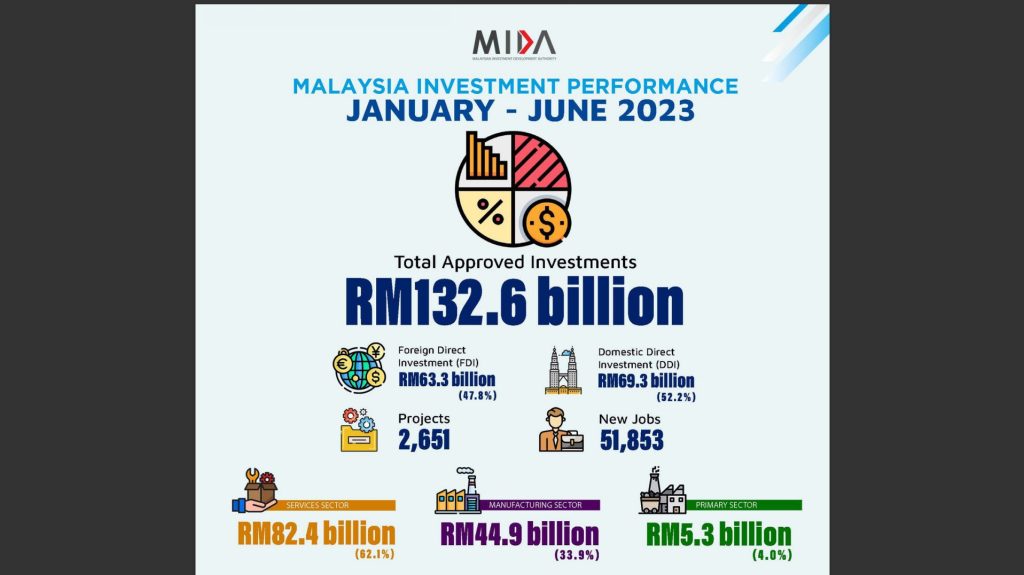
As is Malaysia is on an upward trajectory for both DDIs and FDIs. With the former, according to the Malaysia Investment Development Authority (MIDA), DDIs for the first half of 2023 reached RM69.3 billion (~USD14.6 billion), with all three focus sectors — services, manufacturing, and primary industries — outperforming FDIs. For the latter, it recorded RM69.3 billion (~USD13.4 billion) within the same period.
This is in line with the recent points that both Anwar and the Ministry of Investment, Trade, and Industry, Tengku Zafrul Abdul Aziz made.

“Strategic DDI has the potential to attract more FDI, because foreign investors usually consider DDI as the benchmark for domestic investors’ confidence and commitment towards government policies. This, in turn, will strengthen the nation’s investment and business landscape,” Anwar said at the recent charing of the second National Investment Council.
As for Tengku Zafrul, he shared how the KPIs that have been set in stone does not only concentrate on FDIs, but also encompasses DDIs. For him, it means government-liked investment companies must be aligned with government goals and KPIs to provide local companies with investment opportunities and support.
Expectations for the upcoming Budget 2024 are very much about how it must be more progressive and supportive of the local economy. More insights — from analysts and economists; private sector; and government-linked agenceis — will be shared in the coming weeks.