
With initiatives like the New Energy Transition Roadmap (NETR) and New Industrial Master Plan 2030 (NIMP 2030) focused on sustainability and green energy efforts, it is clear that green investments are a big focus for Malaysia. This had been a key point for Bank Negara Malaysia (BNM) Governor, Abdul Rasheed Ghaffour during the roundtable with the Malaysia press at the recent 28th Conference of Parties (COP28).
It had been during this sharing that he reaffirmed BNM’s commitment to facilitate the transition to a net-zero economy. Beyond the two new roadmaps, one of which directly focuses its efforts on climate change, there are other projects that focus heavily on sustainability and green investments.
“From the many, 10 flagships will cover the six important levers of the green economy that will (directly) support economic growth for next year and the coming three to five years. This includes the Hydrogen Economy and Technology Roadmap (HETR); projects that are directly connected to environmental, social, and governance (ESG) issues; and all green energy efforts under the purview of NIMP 2030,” he added.
Notably, this is not the first time Abdul Rasheed had shared about Malaysia’s ongoing efforts to focus on the green economy. During his address at the Joint Committee on Climate Change Conference (JC3), he shared how Malaysia is already on the road to develop and deploy reneweable energy initiatives and that had doubled-down on its efforts to push forward for a net-zero economy.
“More than ever, climate change is hitting closer to home. (As is,) issues affecting the climate and economy are (now) increasingly connected. (As such,) BNM will provide a policy environment to advance financial innovations and explore financial structure that meet climate risk mitigation and (drive up) adaptation of finance needs. BNM is also undertaking a review of its regulations to ensure climate risk is appropriately accounted for and well-integrated into our regulatory framework,” Abdul Rasheed added.
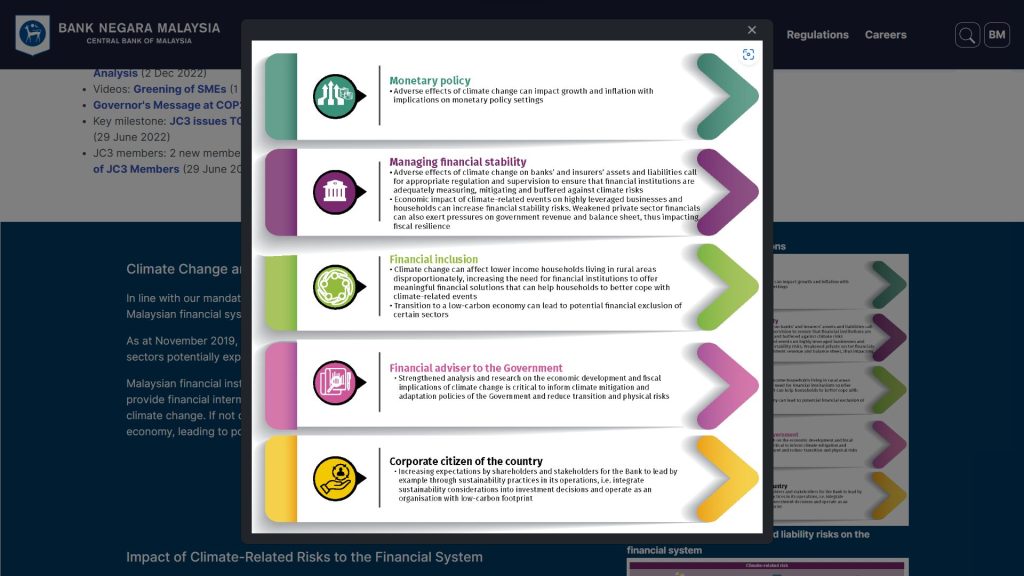
To support this transition, BNM already developed new processes that will promote alignment between financial institutions and their public commitments. At the same time, it will also work towards the goal of safeguarding against greenwashing and also drive up engagement with ministries, agencies, and the community to improve the availability and accessibility of climate-related data.
“I believe the case for climate is no longer in question. (In fact,) the financial industry had made good strides to rise to the challenge. But much, much more is needed — both to close pre-existing gaps and to meaningfully move forward. We know the perils of complacency and the rewards of climate action. The clock now ticks urgently for our response,” he said.
For 2024, BNM had already put in a climate risk stress as part of its plans.